Baroxon® | Leading Boom Barrier Manufacturer

Boom Barriers for High-Traffic Entrances: A Selection Guide
Release time:
2026-10-28
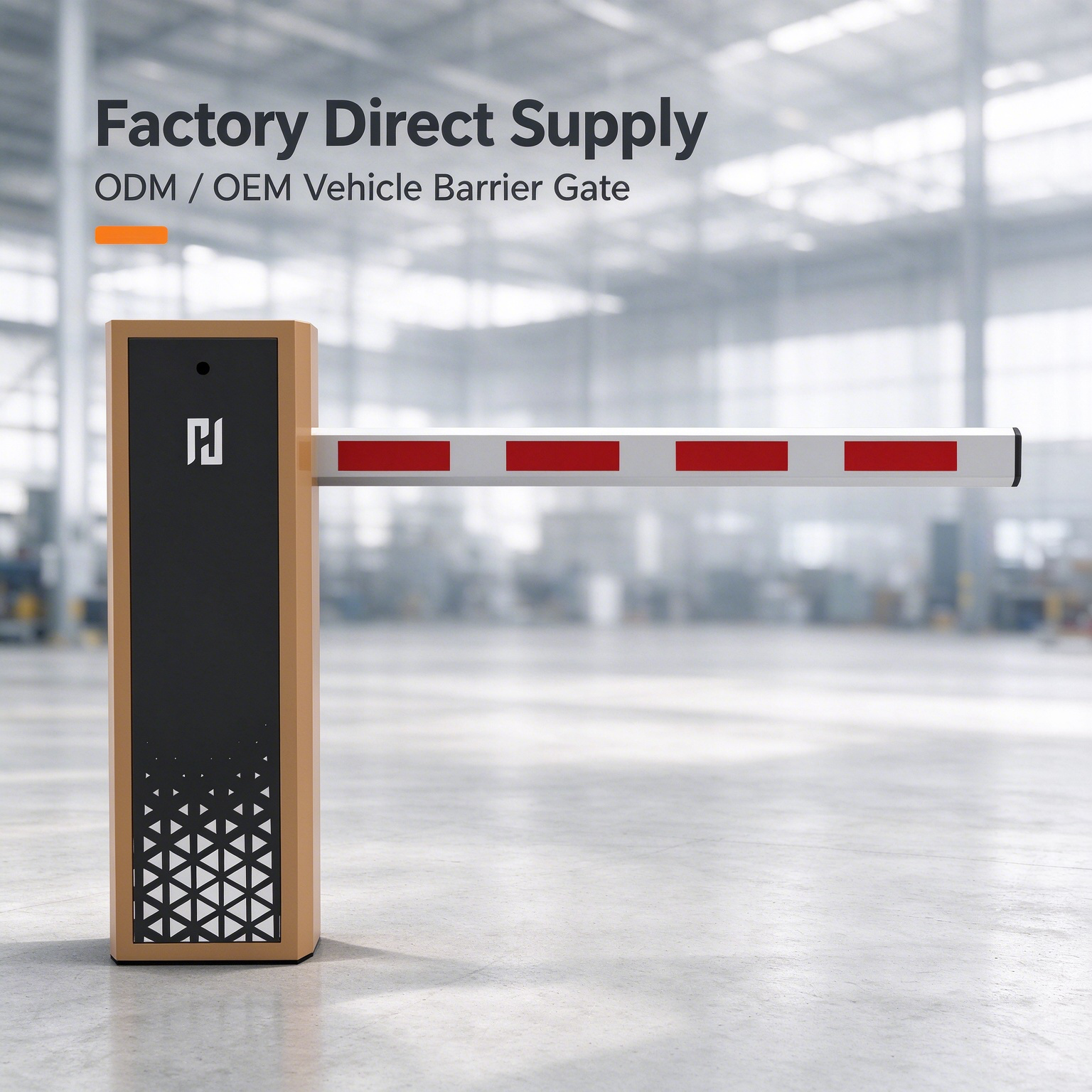
A high-traffic entrance is not simply an entrance with a fast barrier. It is an entrance where the equipment performs many consecutive cycles, where a single failure creates a queue within minutes, and where the weakest element of the chain — identification, lane geometry, software or mechanics — defines the real capacity. Selecting equipment for such a site requires a different set of questions from selecting a barrier for a private yard.
1. What counts as a high-traffic entrance?
Shopping centre and business park car parks, paid parking zones, logistics terminals, industrial sites, residential complexes with a large visitor flow and vehicle checkpoints all qualify. In peak hours the equipment may perform a long series of open-close cycles with almost no pause, so a model designed for occasional use is not suitable even if its opening time looks acceptable on paper. The first question is therefore not "how fast" but "how many cycles per day, and how many in the peak hour".
2. Which characteristics matter most?
2.1 Duty cycle and mechanism service life
Check the declared duty cycle, the permitted number of operations per day and the rated life of the mechanism. For sites with continuous flow, models intended for intensive or continuous operation should be considered. In the BAROXON range, individual model pages list options with duty cycles up to 100%, a rated load of up to 5,000 cycles per day and component life that depends on configuration. These figures apply to specific models and test conditions and must be confirmed in the data sheet of the selected product.
2.2 Opening speed and real throughput
A fast opening reduces waiting time but does not by itself guarantee higher throughput. Consider the full cycle: vehicle detection, permission check, arm lift, vehicle passage and safe closing. For a number of BAROXON barriers the opening time is configurable, for example from a fraction of a second to several seconds depending on model and arm. Do not automatically select the minimum opening time: a long arm, wind load and safety requirements all affect the permissible settings.
2.3 Arm length and arm type
A straight arm suits a standard lane with sufficient vertical clearance. A folding arm can be useful indoors or at entrances with a height restriction. A fence-type arm helps to close a wider area visually where this matches the layout and the safety rules. Some sites need a non-standard lane width; BAROXON offers models and configurations with different arm lengths, and some product pages state that adjustment or project-specific manufacturing is available.
2.4 Motor, enclosure and environmental protection
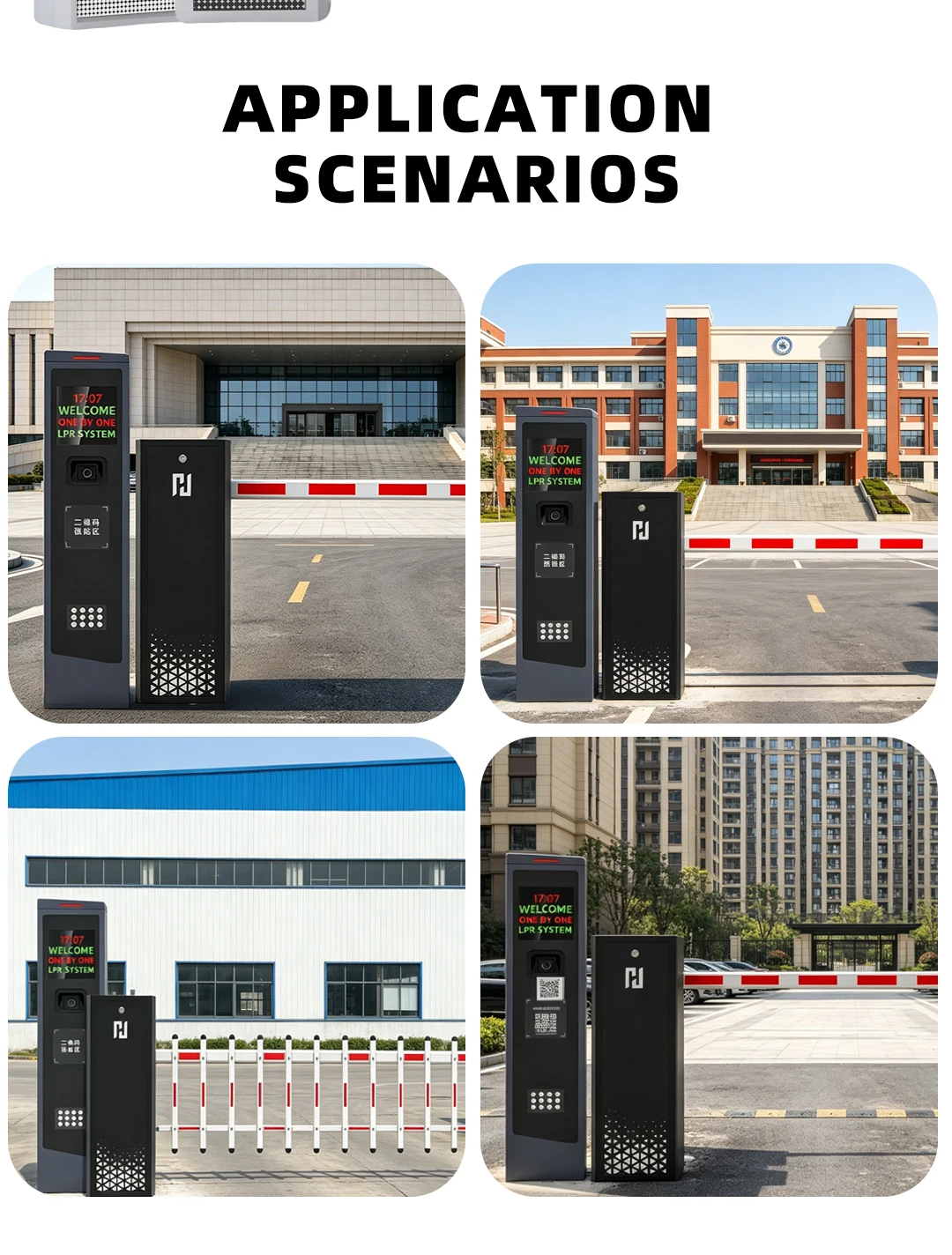
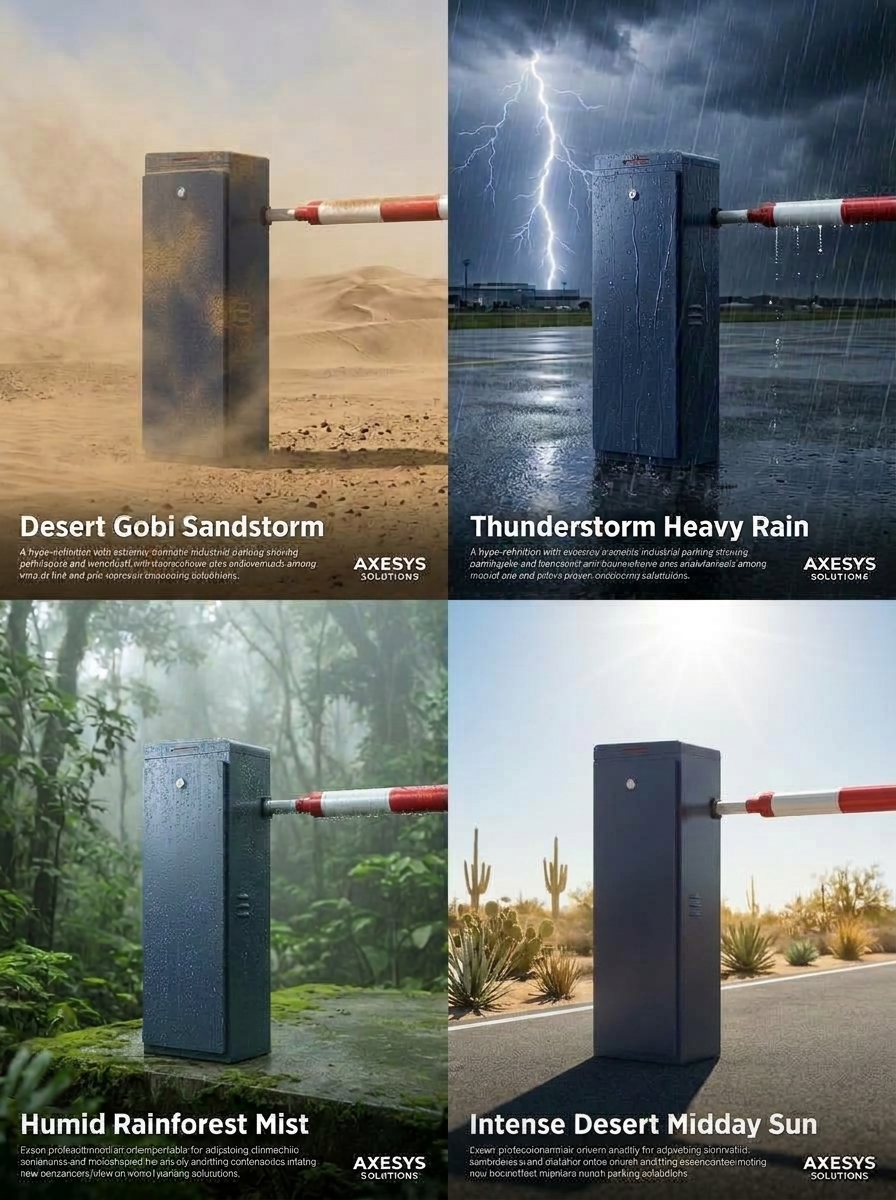
For frequent cycles, drive stability, spare parts availability and serviceability matter. The BAROXON range includes solutions with brushless DC motors as well as variants with different drive and enclosure characteristics. For cold-climate installation, verify the operating temperature range of the specific model, the ingress protection of the enclosure, moisture and dust protection, anti-corrosion coating and compatibility with the local power supply. Do not transfer the characteristics of one model to the whole range.
3. Integration with the access control system
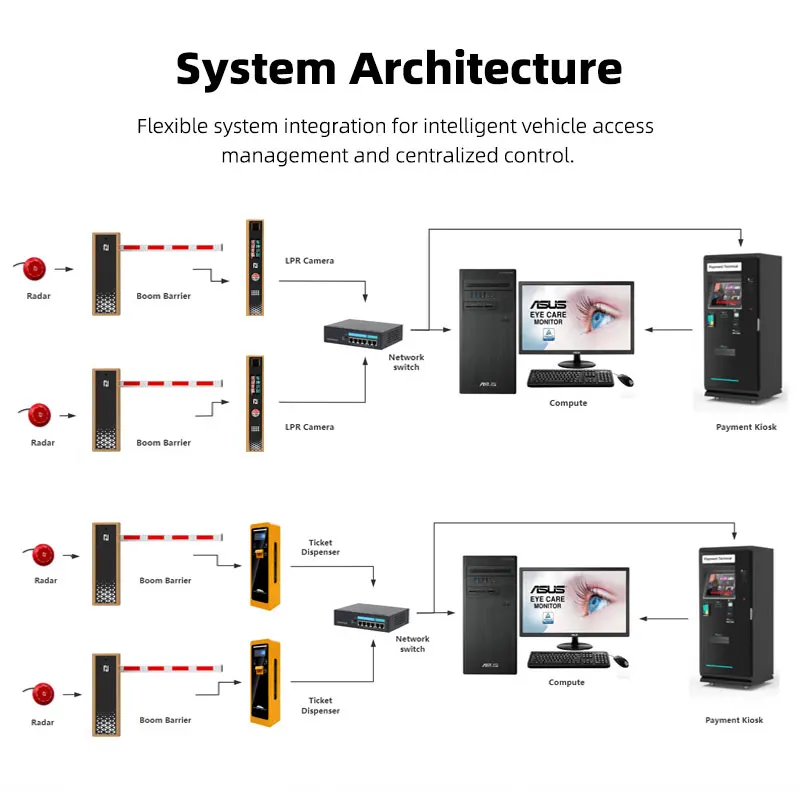
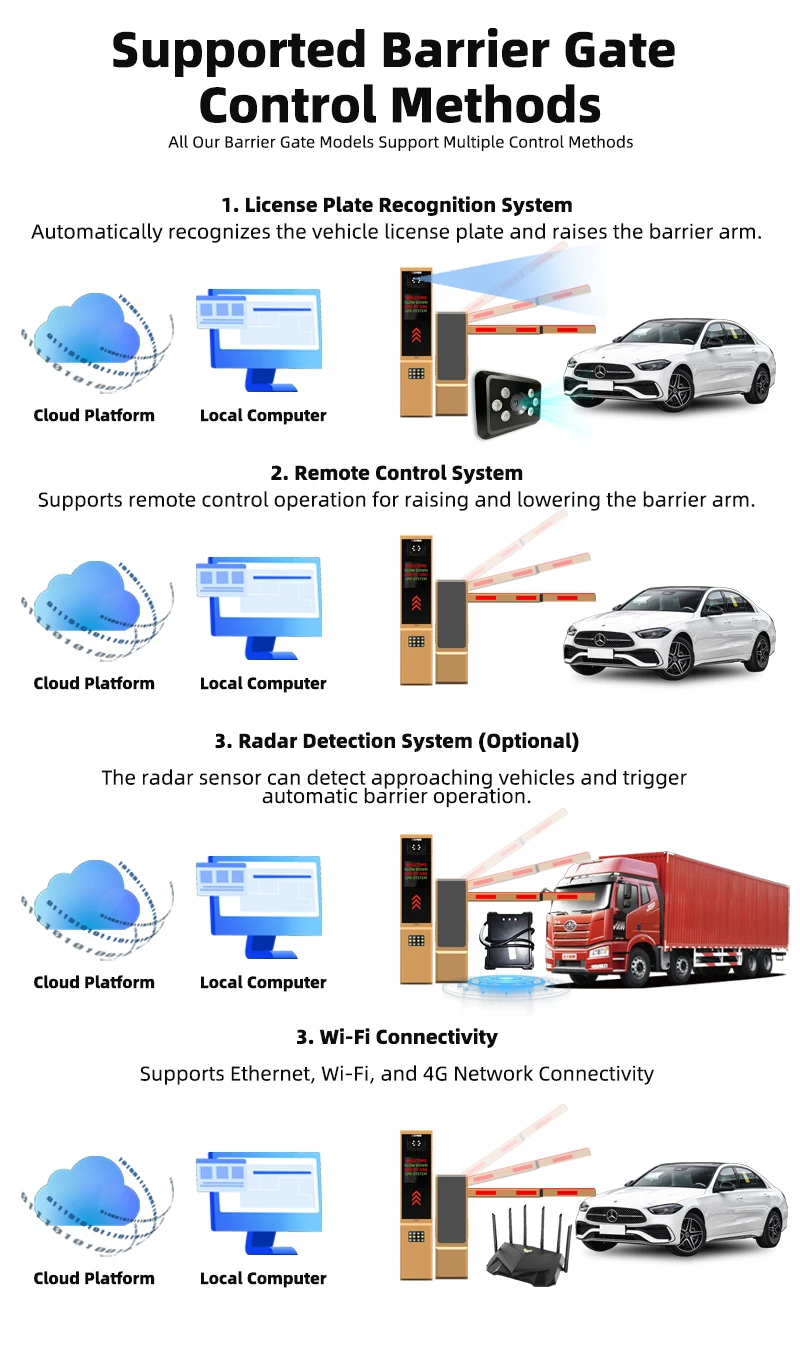
A barrier works better as part of an entrance management system. Depending on the task it can be connected to access cards, a code or QR pass, a UHF RFID reader, a license plate recognition system, an operator button or parking management software. BAROXON offers barriers and related solutions for RFID and plate recognition; actual compatibility depends on the controller, the interfaces, the software version and the selected configuration.
RFID or license plate recognition?
RFID is convenient for regular users and company vehicles when tags or cards can be issued. LPR/ANPR verifies the plate without a physical card and can be convenient for visitors and season-ticket holders. Sites with mixed traffic sometimes use both. Before purchase, agree the access rules, the handling of unregistered vehicles, the storage of event logs and the system behaviour when communication is lost.
4. Safety under a heavy vehicle flow
High speed must not reduce safety. Provide vehicle detection in the arm zone, anti-crash protection and compatible detection devices such as an inductive loop, photocells or a radar sensor. BAROXON has a separate radar sensor category and barrier models with anti-collision functions; confirm which sensors are included, which are purchased separately and how they connect to the selected controller.
Mark the lane, provide lighting, warning signs and a safe waiting area. Do not route a pedestrian path directly under the arm. Acceptance testing should include the sensors, the emergency manual control, the behaviour on power and network failure, and the scenario of a vehicle following closely behind the previous one.
5. How to reduce queues at the entrance
To increase throughput, first measure the actual vehicle flow by hour and identify the causes of delay. Sometimes the problem is not the arm speed but a slow credential read, a badly positioned terminal, a narrow lane, poor plate visibility or a manual check of every visitor. Consider visitor pre-registration, separate lanes for regular users and visitors, correct LPR/RFID settings and clear procedures for system failure.
If the flow is very high, compare a single lane with a single barrier against several independent lanes. Consider not only the equipment cost but also the consequence of one lane failing, the available space, the security requirements and the ability to organise entry and exit safely.
6. A practical selection sequence
- Count the flow: average vehicles per hour, peak load and the share of visitors.
- Measure the lane: width, free space above the arm and space for the cabinet.
- Define the durability requirements: cycles per day, duty cycle, expected service life and maintenance schedule.
- Choose the arm and drive: straight, folding or fence — considering geometry, wind load and speed.
- Define the access method: RFID, LPR/ANPR, QR code, card, operator or a combination.
- Design the safety scheme: vehicle detectors, photocells or radar, emergency control and warning devices.
- Verify the operating conditions: temperature, precipitation, dust, corrosion, power supply and network.
- Request confirmation of the characteristics: data sheet, scope of supply, warranty, spare parts availability and support terms.
7. Maintenance and performance control
For a high-traffic entrance, establish a preventive maintenance schedule. Check the arm fixings, the balance, the smoothness of movement, the condition of the gearbox and drive, the photocells and sensors, the cable connections, the enclosure and the warning devices. Keep a log of faults and of cycle counts if the equipment supports such recording. Set the service intervals according to the manufacturer's manual, the actual load and the site conditions.
8. How BAROXON solutions map to site requirements
The BAROXON catalogue includes automatic barriers, high-speed models, barriers for heavy and high-traffic entrances, RFID configurations, LPR/ANPR recognition systems and radar sensors. For a commercial car park it is worth comparing a high-speed barrier with an integrated parking management option; for an industrial or logistics entrance the priorities are arm length, working intensity, outdoor protection and the set of safety sensors; for sites with many visitors, the combination of RFID and plate recognition should be evaluated.
Parameters and available options depend on the model, the arm length, the controller and the project configuration. When requesting a quotation, provide the lane width, the daily and peak-hour vehicle flow, the installation conditions, the access method, the interfaces of the existing software and the required temperature range, and ask the supplier to confirm the technical solution in writing for the specific model.
Frequently asked questions
Which barrier is suitable for intensive traffic?
Choose a model whose data sheet confirms the required duty cycle, permitted load, service life and compatibility with the necessary sensors. The single characteristic "fast opening" is not sufficient.
Is a high-speed barrier always necessary?
No. If the delays are caused by access verification or lane organisation, a faster drive may not solve the problem. First measure the full passage cycle and identify the bottleneck.
Can plate recognition or RFID be connected?
Such integration is possible for compatible configurations, but the controller interfaces, software compatibility and scope of equipment must be confirmed in advance.
What should be verified for a cold-climate installation?
Check the minimum operating temperature of the specific model, the moisture and dust protection of the enclosure, the anti-corrosion finish, the power supply, the safety sensors and the availability of technical support and spare parts.
Conclusion
A high-traffic entrance needs more than a fast barrier: it needs a coherent system of a suitable drive and arm, reliable access control, safety sensors and a clear maintenance regime. Start by measuring the flow and defining the site requirements, then compare the confirmed parameters of specific BAROXON models and request written confirmation of the configuration before purchase.
Latest News
Baroxon® | Leading Boom Barrier Manufacturer
Advanced Security Access Control and Intelligent Parking Solutions.
Company Strength
Adequate Inventory
Fast Shipping
Our Products
CONTACT US
Address: No. 2 Wanshou Road, International Innovation Industrial Park, Jinan, Shandong, China







© 2026 Baroxon® | Leading Boom Barrier Manufacturer

Contact Us
Our passion is to bring your ideas to life. Work with our design team to create a one-of-a-kind custom finish or cladding system to create a truly unique space. Together we can make your story stand out. If you need something to request a sample, request pricing, or request a demo, please fill out the contact form below. Explain your request in as much detail as you can and a representative will contact you within 1 business day.