Baroxon® | Leading Boom Barrier Manufacturer

What Is a Parking Barrier and How Does It Work?
Release time:
2026-10-28

A parking barrier is an automatic device that blocks and opens a single lane of vehicle traffic. It controls who enters a car park, a residential compound, a corporate site or a logistics yard, and it records when each vehicle passed. In everyday use the words "barrier", "boom barrier" and "parking gate" are often mixed together; technically they describe the same class of equipment — a cabinet with a drive and an arm that lifts to let a vehicle through.
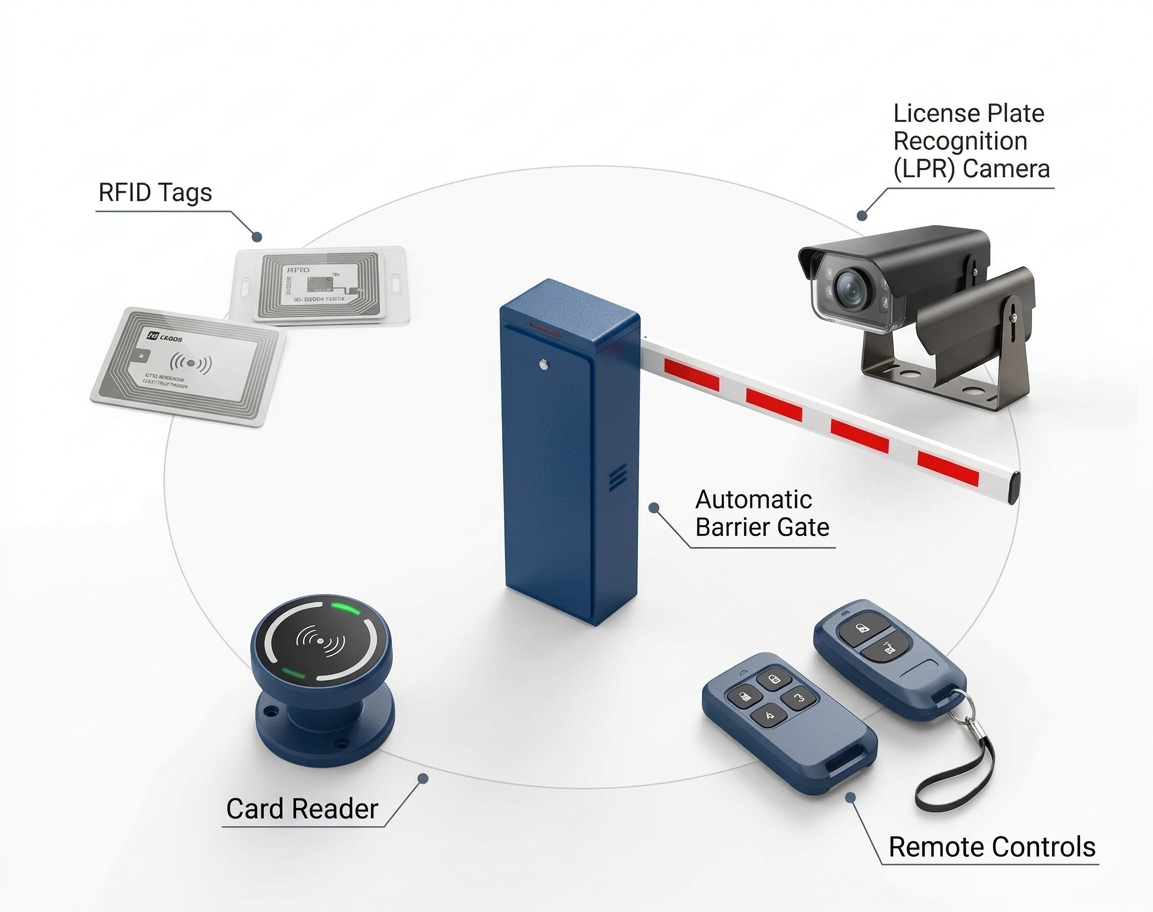
What components does a parking barrier consist of?
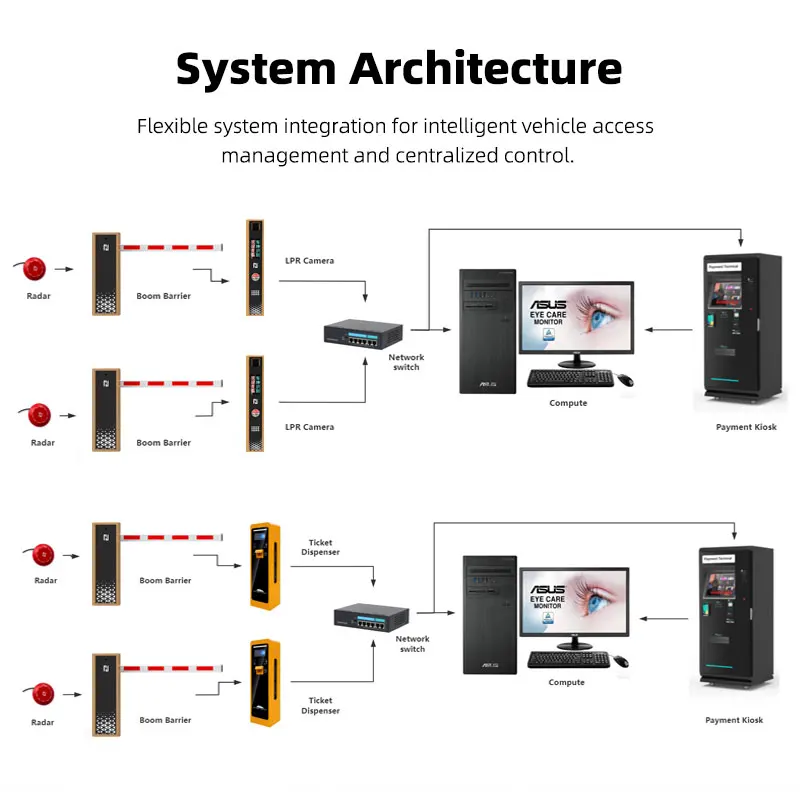
Every automatic parking barrier contains the same functional blocks, regardless of the manufacturer. The cabinet holds the motor, the reduction gear and the control board. The arm blocks the lane. The controller processes signals from readers and sensors. Identification devices — a card reader, a UHF reader, a camera, a keypad or an intercom — establish the right to enter. Safety devices — inductive loops, photocells, radar — protect the vehicle and the arm during the cycle. A barrier without identification is a manual gate; a barrier without safety devices is a risk.
The quality of a barrier is decided less by the arm than by the cabinet: the motor type, the gearbox, the balance mechanism and the sealing of the enclosure determine how many cycles the unit will survive and how it behaves in rain, dust and frost.
How an automatic parking barrier works: step by step
1. The vehicle approaches the entrance
The vehicle enters the detection zone. An inductive loop buried in the road surface, a radar sensor or the recognition camera triggers the system. The arm is down and the controller is waiting for a credential.
2. The system checks the access right
The controller or the parking software compares the credential with the access rules: a valid card, a plate on the allow list, an expected visitor, an available parking space. This stage defines the real speed of the lane, because a mechanical opening of one second is irrelevant if the verification takes eight.
3. The controller starts the drive
After a positive decision the controller sends the open command. The drive releases the balance spring, the arm lifts and the lane opens. The opening time depends on the model and on arm length — a short arm on a high-speed drive opens in a fraction of a second, while a long arm on a standard drive needs several seconds.
4. The vehicle drives through the lane
While the vehicle is in the passage zone, the safety devices keep the arm from lowering. A loop detector, photocells or radar confirm that the lane is occupied. If the vehicle stops under the arm, the arm remains open.
5. The arm closes after the lane is clear
Closing is triggered by the loop releasing, by a time delay or by a command from the parking software. A correct setting of the closing delay is what prevents the classic accident of an arm coming down on a trailer or on a second vehicle following closely.
6. The system can store the passage event
The event — time, credential, plate, lane, result — is written to the controller log or to the parking software. This record is the basis for occupancy statistics, revenue reconciliation and dispute resolution.
Which types of parking barriers exist?
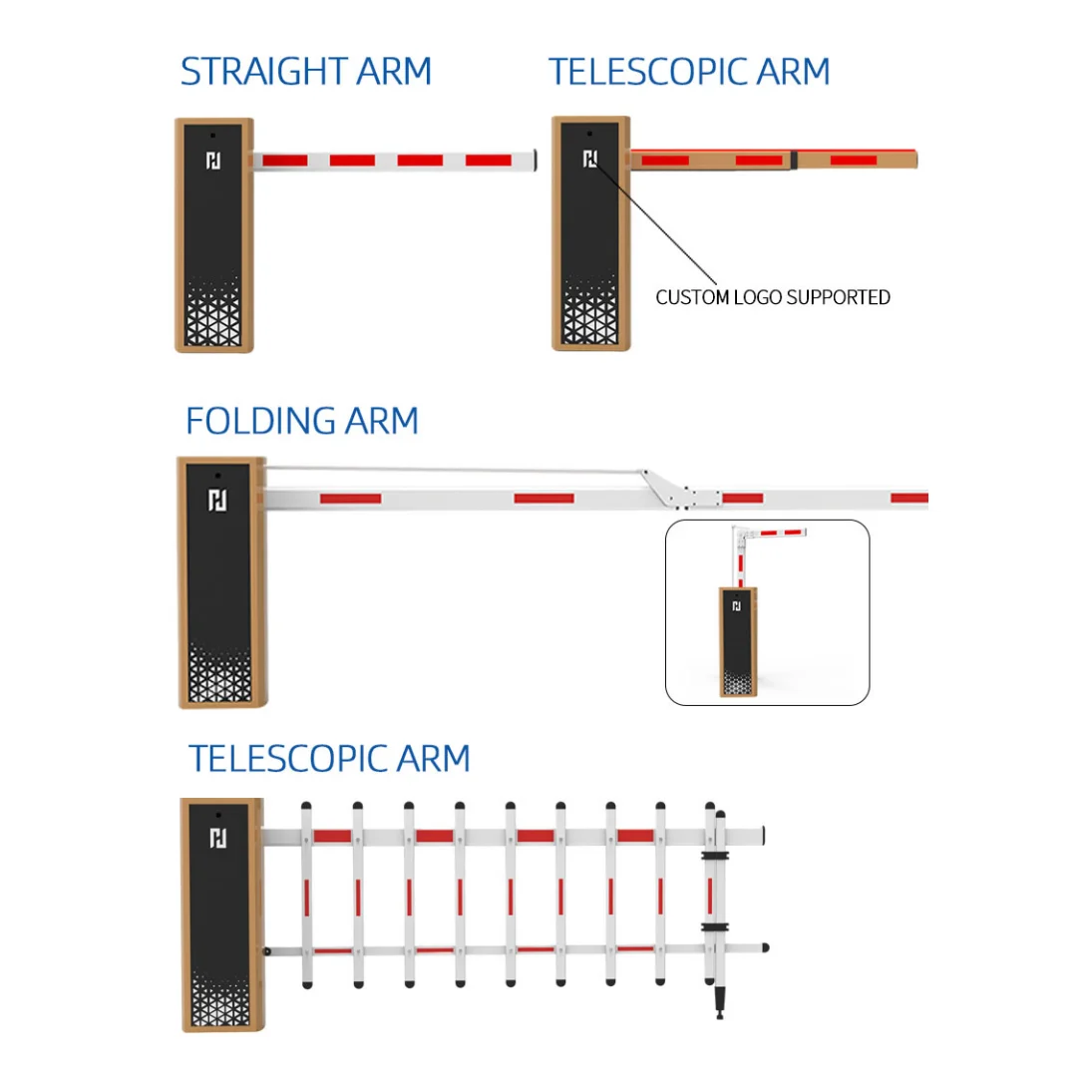
Barriers are classified by arm type and by drive class. A straight arm is the standard solution for an open lane with free space above it. A folding arm is used where a ceiling, a pipe or a canopy limits the lifting height, typically in underground car parks. A fence-type arm covers a wider opening and is chosen where the visual closure of the lane matters. Separately, barriers are classified by duty cycle: models for occasional use, models for commercial car parks and models for continuous high-traffic operation. The arm and the duty cycle have to be selected together, because a long arm on a light-duty drive is a guaranteed early failure.
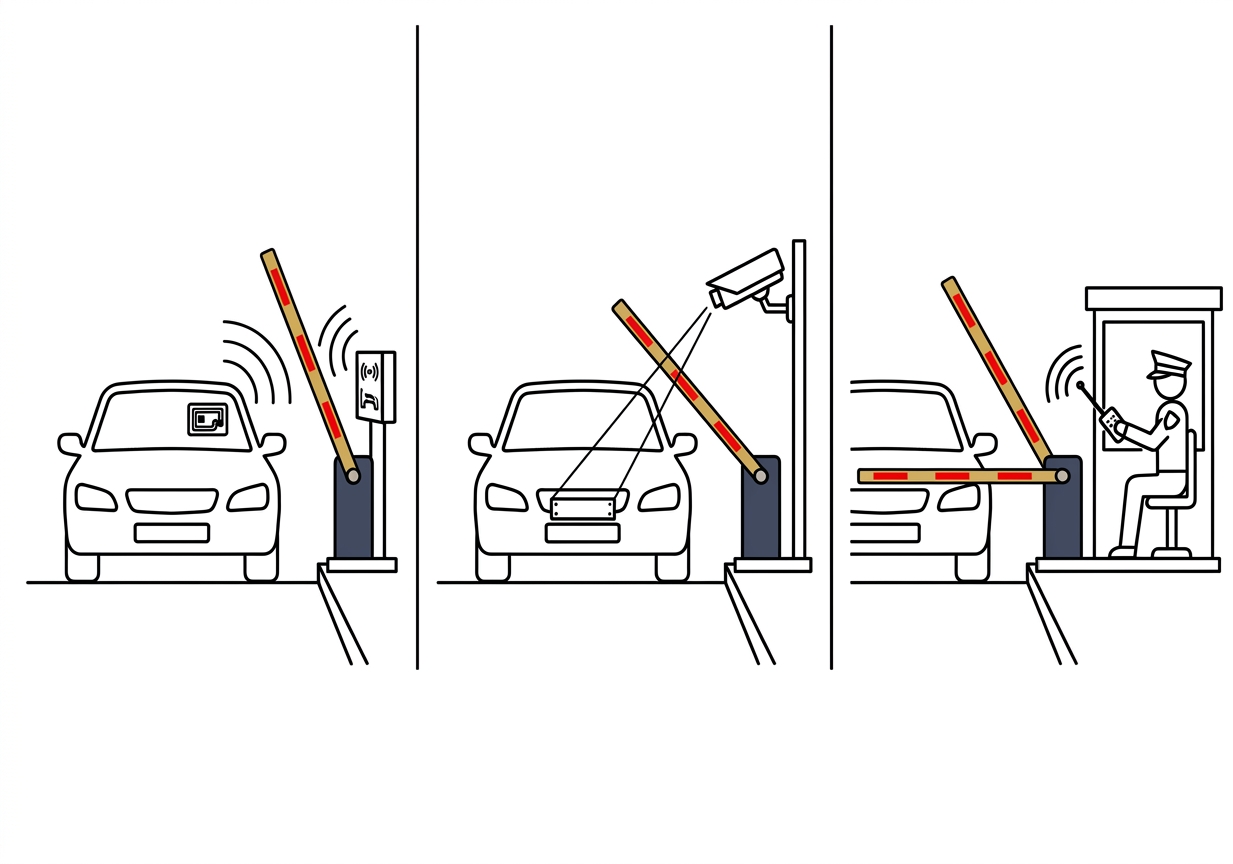
How does the barrier integrate with RFID and license plate recognition?
An RFID reader identifies a card or a UHF tag at a distance and sends the credential to the controller. It is fast, weather-independent and well suited to residents, staff and regular contractors. License plate recognition (LPR/ANPR) reads the plate with a camera and compares it with a list in the software. It requires no physical credential, which makes it convenient for visitors and mixed traffic, but it depends on camera position, lighting and plate condition. In practice the two technologies are often combined: RFID for regular users, recognition for guests and a manual button or intercom for exceptions.
Safety and maintenance
Safety begins with detection: a loop, photocells or radar must confirm that the lane is free before the arm closes. The second layer is the anti-crash function, which stops and reverses the arm when it meets an obstacle. The third layer is manual release, which allows the arm to be lifted by key or crank during a power failure. Maintenance is simple but not optional: check the arm fixings and balance, inspect the hinges and the reduction gear, clean the photocells, test the loops and verify the emergency release. A barrier that is never serviced fails at the busiest hour.
How to choose a barrier for a specific site
Define four parameters before looking at models. Lane width and clearance above the lane determine the arm type and length. Vehicles per day and per peak hour determine the duty cycle. The access method — card, tag, plate, QR code, intercom or operator — determines the controller and the interfaces. Climate and installation conditions determine the enclosure protection and the operating temperature range. With these four parameters a supplier can propose a confirmed configuration instead of a generic brochure model.
Frequently asked questions (FAQ)
Is a barrier the same thing as a parking barrier?
Yes. "Boom barrier", "parking barrier" and "automatic barrier" describe the same equipment: a cabinet with a drive and an arm that opens a single lane. The differences between products lie in the drive class, the arm type and the controller, not in the name.
Can a barrier open automatically by license plate?
Yes, if an LPR/ANPR camera and software are part of the system. The camera reads the plate, the software checks it against the allow list and sends an open command to the controller. The barrier itself does not recognise plates — it only executes the command.
Which arm type is better for an underground car park?
A folding arm is usually the right choice, because the ceiling height does not allow a straight arm to lift fully. The exact configuration has to be confirmed after measuring the height to the lowest obstacle and checking the arm trajectory with the manufacturer.
How fast does an automatic barrier open?
Standard models open in a few seconds; high-speed models open in less than a second. The achievable speed depends on the arm length and weight, on the drive and on the safety settings. A very fast opening on a long arm is not a realistic configuration.
Does the barrier work during a power failure?
A barrier with a backup battery continues to operate for a limited number of cycles. Without a battery, the arm can be released manually with a key or a crank so that vehicles can leave the site. The release procedure should be documented in the site's emergency instructions.
Conclusion
A parking barrier is a compact access control system: identification, decision, movement, confirmation. Its real performance depends on how well the arm, the drive, the controller and the safety devices match the lane and the traffic. Measure the entrance, count the vehicles, define the access method — and only then compare models on confirmed technical data.
Latest News
Baroxon® | Leading Boom Barrier Manufacturer
Advanced Security Access Control and Intelligent Parking Solutions.
Company Strength
Adequate Inventory
Fast Shipping
Our Products
CONTACT US
Address: No. 2 Wanshou Road, International Innovation Industrial Park, Jinan, Shandong, China







© 2026 Baroxon® | Leading Boom Barrier Manufacturer

Contact Us
Our passion is to bring your ideas to life. Work with our design team to create a one-of-a-kind custom finish or cladding system to create a truly unique space. Together we can make your story stand out. If you need something to request a sample, request pricing, or request a demo, please fill out the contact form below. Explain your request in as much detail as you can and a representative will contact you within 1 business day.