Baroxon® | Leading Boom Barrier Manufacturer

What Is an Automatic Boom Barrier? Types, Applications and Working Principle
Release time:
2026-10-28
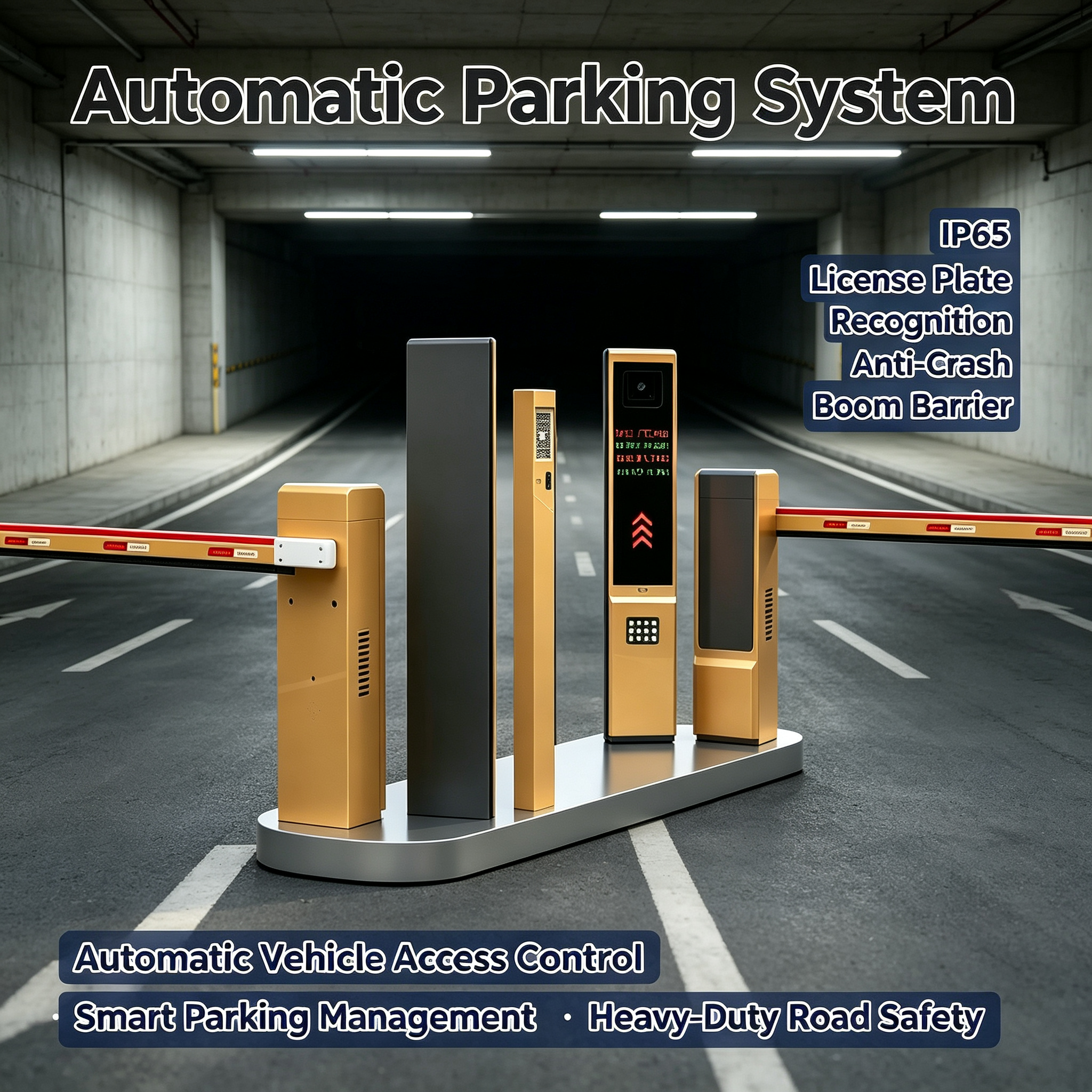
An automatic boom barrier is an electromechanical device that opens and closes a single lane of vehicle traffic without manual effort. It is used wherever vehicles have to pass a checkpoint — car parks, residential compounds, office centres, industrial sites, logistics terminals and toll points. The device is simple in principle and varied in execution: the same basic idea covers a light barrier for a private yard and a heavy-duty unit that performs thousands of cycles a day.
What does an automatic barrier consist of?
The cabinet contains the electric motor, the reduction gear, the balance mechanism and the control board. The arm is attached to the output shaft through a flange and a balance spring compensates most of its weight. The controller processes signals from readers, buttons, loops and sensors. Identification devices establish the right to enter, and safety devices confirm that the lane is clear before the arm closes. Optional modules include a battery backup, a warning lamp, a heater and network interfaces.
How does an automatic barrier work?
The sequence is always the same. A vehicle arrives and triggers detection. A credential is presented or read: card, tag, plate, QR code or a command from the operator. The controller verifies the permission and energises the drive. The motor rotates the output shaft, the balance spring helps lift the arm, and the arm stops in the vertical position. The vehicle passes over the loop, the loop releases, and after a configurable delay the controller reverses the cycle and the arm lowers. If any safety input is active during the closing movement, the arm stops and returns to the open position.
Main types of automatic barriers
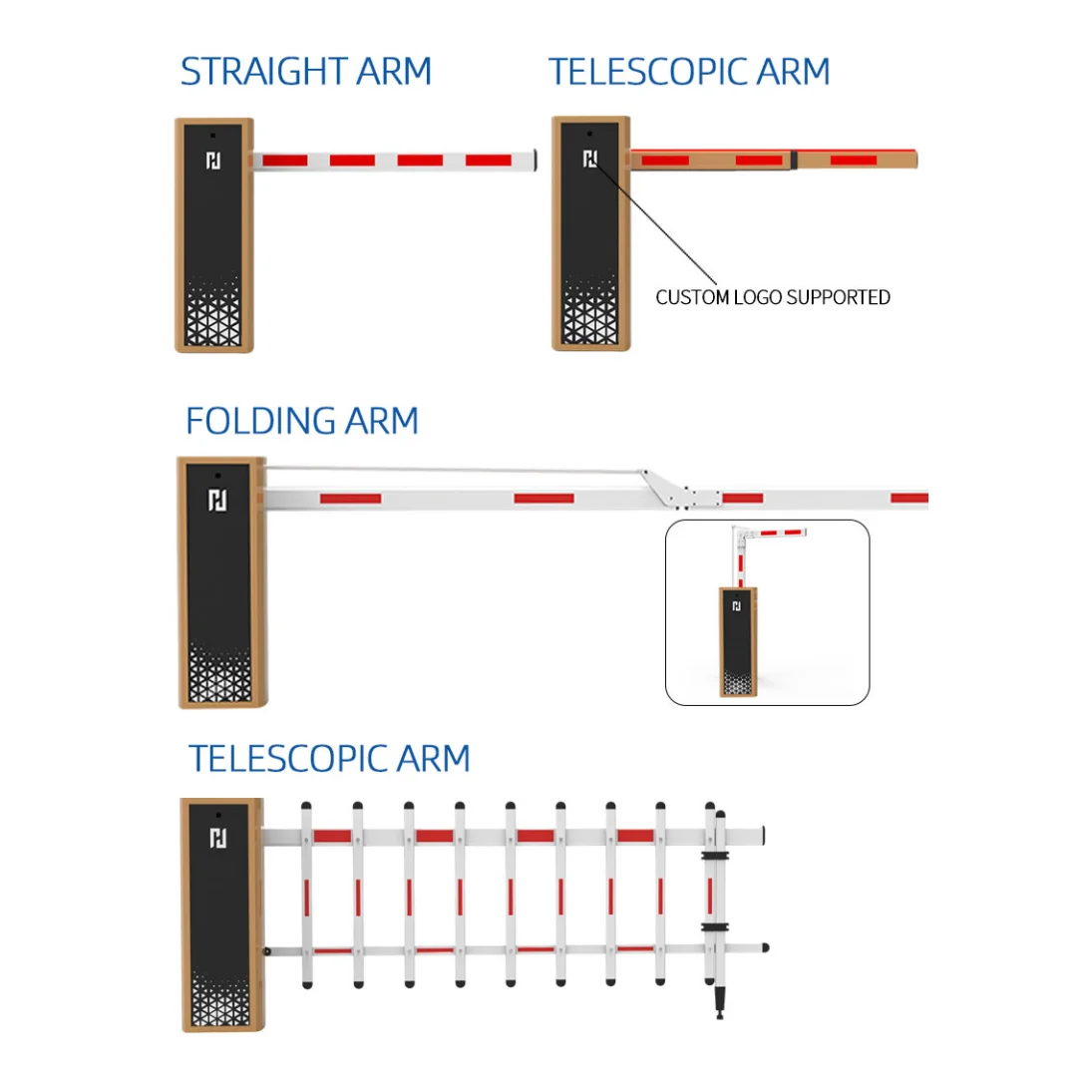
1. Barrier with a straight arm
The most common type. A rigid arm lifts to the vertical position and blocks a lane of standard width. It requires free space above the lane equal to the arm length, and it is the cheapest and simplest configuration for an open entrance.
2. Barrier with a folding arm
The arm is divided into two or three sections connected by hinges. When lifting, the sections fold and the arm needs much less vertical clearance. This is the standard solution for underground car parks, covered passages and entrances under a canopy.
3. Barrier with a fence arm
A fence-type arm consists of a frame with vertical bars and closes a wider opening than a single bar. It is used where the visual closure of the lane matters — for example at the boundary of a secured perimeter — and where a vehicle should not be able to pass under or over the arm.
4. High-speed or high-traffic barrier
A barrier built for a high number of cycles per day, with a reinforced drive, a heavier gearbox and a controller designed for continuous operation. Opening times can be below one second with a short arm. These models are chosen for commercial car parks, paid parking, logistics terminals and any entrance where a queue forms quickly.
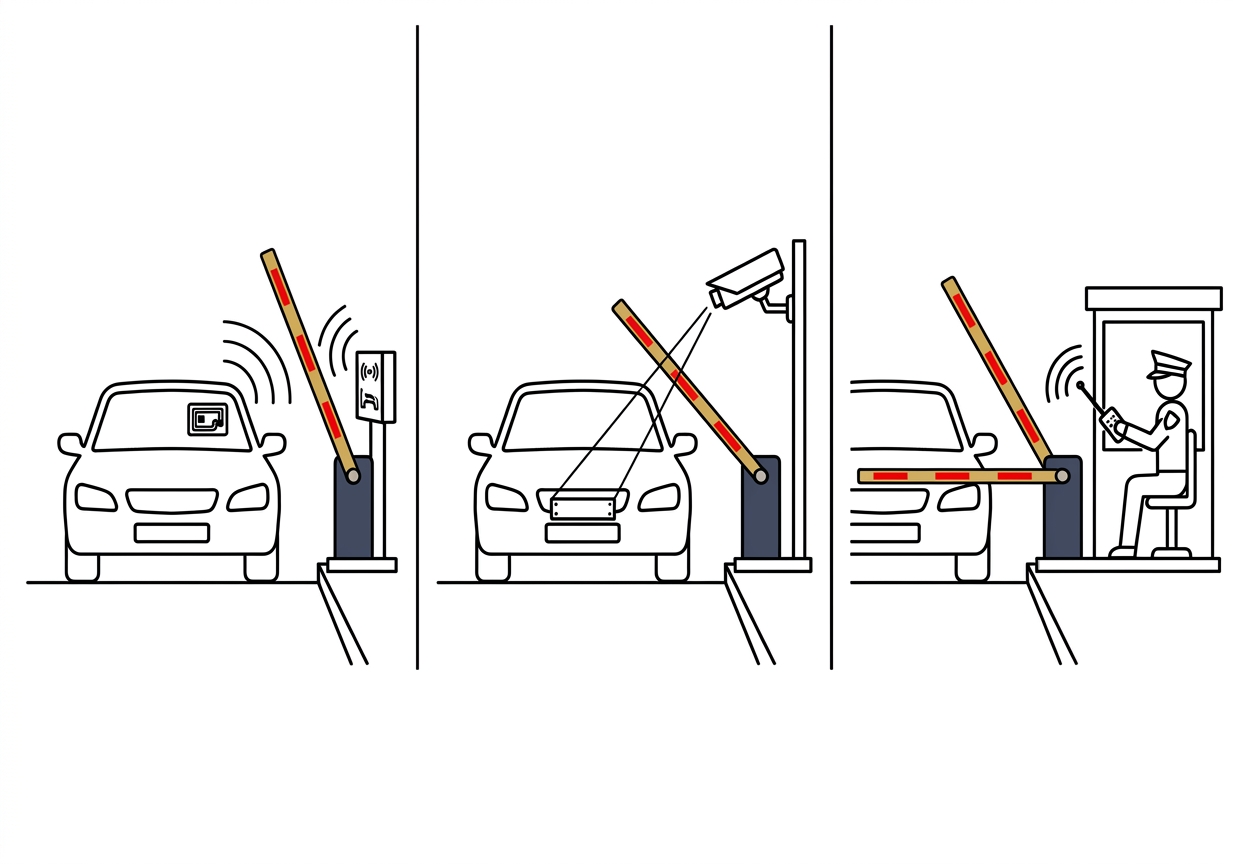
5. Barrier with RFID or license plate recognition
A standard barrier combined with an identification subsystem: a UHF reader, a card reader or an ANPR camera with recognition software. The barrier itself is unchanged; the value is added by the identification layer, which removes the need for a driver to stop, roll down the window and present a card.
Where are automatic barriers used?
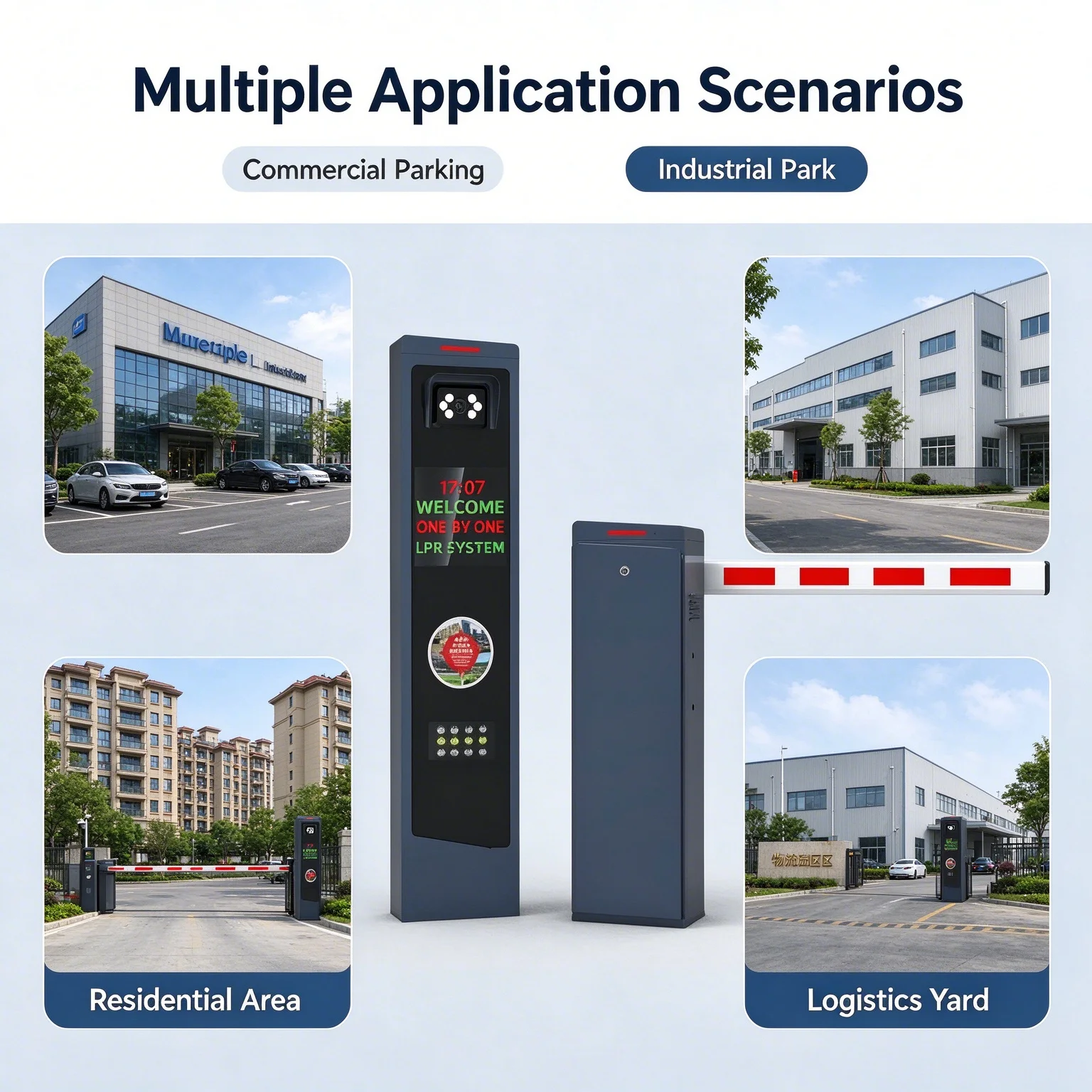
Residential compounds and gated communities use barriers to control resident and visitor access. Office and business centres use them to separate tenant parking from visitor parking. Shopping centres and paid car parks use them together with ticket or recognition systems to manage occupancy and revenue. Industrial sites and logistics terminals use heavy-duty barriers at gatehouses, weighbridges and dock entrances. Hospitals, universities and public institutions use them to keep limited parking capacity available for the people who need it.
How to choose an automatic barrier for your site
Start with the lane: width, clearance, and whether the ground can accept a foundation. Then the traffic: vehicles per day and per peak hour, and the share of visitors who need a manual procedure. Then the access method and the required interfaces. Then the climate: minimum temperature, snow, dust, salt on the road. Finally the service model: who will maintain the barrier and how quickly spare parts can be supplied. A barrier that matches all five dimensions will work for years; a barrier chosen only on price will be replaced early.
Safety and maintenance
Safety requires detection before closing, anti-crash protection during closing, and a manual release for power failure. A barrier installed without a loop or photocells is a hazard regardless of how fast it opens. Maintenance is a short, scheduled procedure: check the arm fixings and balance, inspect the hinges, the spring and the gearbox, clean the sensors, test the emergency release and verify the controller settings. Sites that skip maintenance usually discover the problem when the arm stops in the down position during the morning peak.
Frequently asked questions
Is an automatic barrier the same as a gate?
No. A gate usually covers a wider opening and is often intended for pedestrians or for vehicles with a swing or sliding movement. A barrier controls a single lane with a lifting arm and is designed for repeated, fast vehicle cycles.
Can a barrier be controlled automatically by license plate?
Yes, when an ANPR camera and recognition software are part of the system. The camera reads the plate and the software sends an open command to the barrier controller. The barrier does not perform recognition itself.
Which barrier is best for an underground car park?
A folding-arm barrier, because the ceiling does not allow a straight arm to lift. The exact model and arm length must be confirmed after measuring the height to the lowest obstacle and checking the folding trajectory.
Does one type of barrier suit every site?
No. A light barrier for a private yard, a high-speed barrier for a paid car park and a heavy-duty barrier for a logistics terminal are different products with different drives, gearboxes and controllers. Using a light model on a heavy site is the most common cause of early failure.
Conclusion
An automatic boom barrier is a mature, well-understood product, and most failures come from a mismatch between the product and the site rather than from the technology itself. Define the lane, the traffic, the access method, the climate and the service model first, then choose the type and the model. Confirmed technical data, not the brochure picture, should be the basis of the decision.
Latest News
Baroxon® | Leading Boom Barrier Manufacturer
Advanced Security Access Control and Intelligent Parking Solutions.
Company Strength
Adequate Inventory
Fast Shipping
Our Products
CONTACT US
Address: No. 2 Wanshou Road, International Innovation Industrial Park, Jinan, Shandong, China







© 2026 Baroxon® | Leading Boom Barrier Manufacturer

Contact Us
Our passion is to bring your ideas to life. Work with our design team to create a one-of-a-kind custom finish or cladding system to create a truly unique space. Together we can make your story stand out. If you need something to request a sample, request pricing, or request a demo, please fill out the contact form below. Explain your request in as much detail as you can and a representative will contact you within 1 business day.